
Global CEX buying and selling volumes are valued at billions of dollars each month. The regulatory environment for cryptocurrency exchanges continues evolving rapidly, creating a posh global patchwork of compliance requirements that significantly influence consumer expertise. In addition, many crypto exchanges offer different features you need to pay for. Another instance is liquidation fees when your collateral must be liquidated.

Faqs About Crypto Exchanges
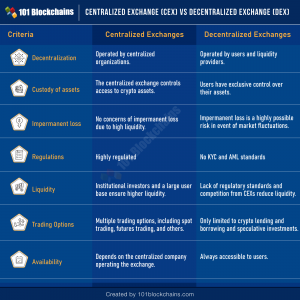
They’re good for customers who wish to manage their assets with out Digital asset relying on a government or those who want to trade smaller tokens not listed on CEXs. Customers who’re new to crypto are likely higher off selecting a centralized crypto exchange. They typically have a virtual library of instructional supplies on all issues crypto-related. Customer help is normally simple to entry, although this varies relying on the trade.
The centralized versus decentralized trade debate ultimately reflects broader philosophical questions about financial sovereignty, comfort, and risk tolerance. Rather than a binary selection, today’s cryptocurrency panorama increasingly rewards those who understand the means to strategically navigate both ecosystems. Public blockchains present a approach to conduct digital commerce without centralized intermediaries. Nonetheless, to draw customers, decentralized applied sciences want to supply features which are a minimal of as compelling as centralized alternate options. If decentralized applications are slower and costlier than centralized alternate options, blockchain-based exercise will likely stay a relatively small a part of online commerce. Regulatory requirements create operational limitations for centralized exchanges, impacting the providers they will present.

A major part of the CEX vs DEX discussion involves fees, liquidity, and accessibility — all key factors that shape your trading experience. Centralized exchanges normally provide greater liquidity, meaning you can execute trades quicker and with more stable prices. This makes shopping for or selling larger quantities simpler without inflicting big price swings. Plus, CEXs are inclined to have transparent charge structures, so you generally know what you’re paying — although hidden prices like withdrawal fees or spreads can typically pop up, catching customers off guard. CEXs are usually more user-friendly, offering easy-to-navigate platforms, customer assist, and numerous buying and selling instruments.
- Study what liquid staking is, the means it works, key advantages & risks, and how to get began utilizing liquid staking tokens (LSTs) in DeFi protocols.
- While the extent of influence varies, this community-driven strategy appeals to customers who prefer decentralised governance over centralised management.
- CEX platforms use an order book system, where purchase and sell orders are listed.
- The smartest strategy is to make use of both strategically, all the time prioritizing management over your individual belongings.
What Future Trends Can We Count On Within The Landscape Of Crypto Exchanges?
CEXs, like Coinbase and Binance, are user-friendly, with excessive liquidity and buyer support, making them ideal for beginners. CEXs typically charge buying and selling charges based on the volume of your trades and will provide discounts for higher volumes or for using native tokens. DEXs typically don’t have platform charges, however you should pay fuel charges for blockchain transactions, which could be unpredictable and expensive throughout network congestion. While this can be handy, it also makes CEXs attractive targets for hackers. Decentralized exchanges (DEXs), however difference between cex and dex, permit you to trade instantly from your individual crypto pockets, supplying you with full control over your assets and personal keys.
A widely held perception is that decentralized exchanges (DEXs) offer lower transaction prices than centralized exchanges (CEXs). Relying on how busy the chain is, a transaction can take fairly a while (and price you some excessive fuel fees) earlier than completing, whereas a centralized exchange executes trades in milliseconds. This week, CMC Academy explains the distinction between centralized and decentralized exchanges for crypto traders with professionals and cons. Atomic swaps use special good contracts known as Hash Time Lock Contracts (HTLCs) to ensure that either each side of a trade execute successfully, or neither does. Think of a decentralized time locked escrow that verifies each side terms are met before releasing funds.
Understanding Centralized And Decentralized Exchanges
High-profile breaches have led to vital losses, highlighting the dangers of third-party key management. A personal key’s used to signal transactions and show ownership of a blockchain address, essential for asset management on DEXs. Explore ApeX—a decentralized platform constructed for control, transparency, and efficiency. Begin small, perceive the differences, and resolve what feels right primarily based on your goals, risk tolerance, and luxury with blockchain tools. CEXs provide comfort and speed, whereas DEXs champion privacy and control.
What’s The Main Difference Between A Centralized Exchange (cex) And A Decentralized Exchange (dex)?
Users must manually adjust slippage tolerance when buying and selling on DEXs, which may be advanced and result in loss if done improperly. Merchants missing specific data may make errors resulting in fund loss. Funds could be completely misplaced if property usually are not on the identical blockchain because the DEX. Improvements in consumer expertise, infrastructure, scaling mechanisms, and connections to monetary institutions are important for the future adoption of DEXs.
Basically, you’re trusting the trade to behave responsibly and remain solvent. Automated market makers (AMMs) facilitate trades on decentralized exchanges by utilizing https://www.xcritical.com/ liquidity pools, which are community-funded reserves of tokens. This system eliminates the necessity for traditional order books and allows continuous buying and selling while rewarding liquidity suppliers with transaction fees. Centralized exchanges (CEX) like Coinbase or Binance act as middlemen holding your funds and processing trades. They supply comfort, excessive liquidity, and sometimes higher customer assist. On the flip aspect, decentralized exchanges (DEX) corresponding to Uniswap or PancakeSwap let you trade instantly from your personal wallet, selling privateness and management however demanding more self-reliance.
